
Are Lathes Dangerous? Real Risks, Common Injuries, and Safety Guide
Affiliate disclosure: This article contains Amazon affiliate links. If you buy through them, we earn a small commission at no extra cost to you. Our safety recommendations reflect widely accepted best practices among experienced turners and machine operators.
The Short Answer
Yes, lathes are dangerous. They spin material at high speeds while a sharp cutting tool works inches from the operator’s face. Serious injuries happen every year, ranging from ejected wood chips striking eyes to catastrophic hair or clothing entanglement.
The good news: the overwhelming majority of lathe injuries are preventable. Wearing proper safety equipment, following ten specific rules, and knowing how to respond to catches or kickback prevents nearly all serious accidents in home shops.
Most important safety purchase: A quality face shield → Honeywell UVEX BIONIC Face Shield
Essential backup protection: Safety glasses worn UNDER the face shield → 3M Safety Glasses
Never wear: Gloves, loose clothing, jewelry, or unsecured long hair. Any of these can catch on the spinning workpiece with catastrophic results.
How Dangerous Are Lathes, Really?
Lathes rank among the more dangerous shop tools because they combine three risk factors that most other tools do not. First, high rotational speed (500 to 4,000 RPM depending on the machine and workpiece). Second, an unguarded workpiece that spins directly in front of the operator’s face and torso at close range. Third, cutting tools that must be held by hand very near the spinning material.
For context, other common shop tools like table saws and routers keep the cutting action in a fixed, partially guarded position. A lathe puts the cutting action in your hands, inches from a piece of wood or metal that could weigh several pounds and spin thousands of times per minute.
That said, lathes are not the most injury-prone shop tool. Table saws produce more injuries per year in absolute terms, largely because far more people own them. Lathes produce fewer total injuries because fewer people use them. But per incident, lathe injuries tend to be more serious because they often involve the face, head, or entanglement rather than fingers.
The 7 Most Common Lathe Injuries
1. Ejected Material to the Face or Eyes
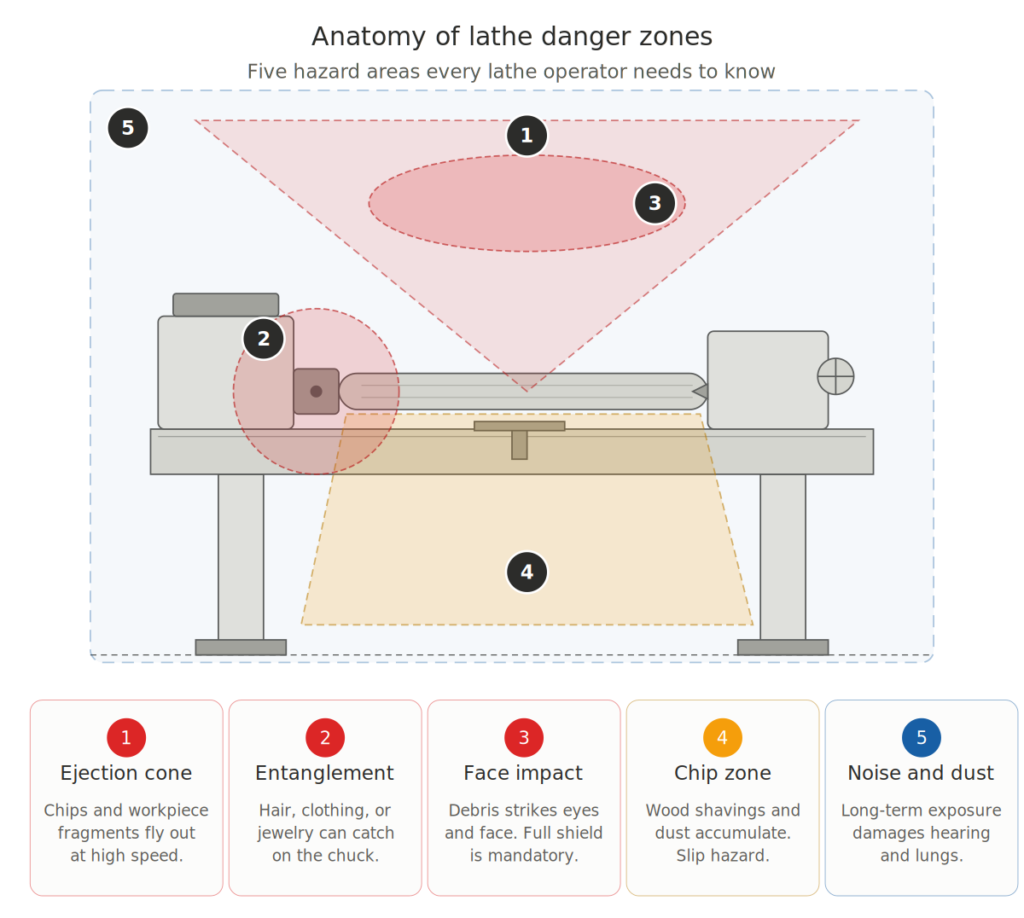
The most frequent lathe injury by far is being struck by material that comes off the spinning workpiece. Wood chips, larger fragments, or entire pieces can fly off at high speed. The distance from the workpiece to the operator’s face is often only 12 to 24 inches, and material can leave the workpiece at speeds exceeding 100 miles per hour on larger diameters.
How it happens: Wood with hidden cracks, knots, or defects flies apart under rotational stress. Metal chips shear off at speed. A poorly secured workpiece separates from the chuck or centers. Bark on green wood breaks free.
Prevention: Always wear a full face shield. Inspect wood carefully before turning. Use appropriate speeds (slower for larger diameters). Never turn wood with visible cracks or splits. Do not stand directly in line with the workpiece when starting the lathe.
2. Hand and Finger Contact With Spinning Material
Reaching too close to the spinning workpiece results in contact injuries. This can happen when adjusting the tool rest, checking measurements, brushing off shavings, or reacting to a catch.
How it happens: Fingers, thumbs, or hands accidentally touch the spinning wood or metal. Even light contact at 2,000 RPM causes severe friction burns and can pull the hand into the machine.
Prevention: Never adjust the tool rest, calipers, or workpiece while the machine is running. Turn the lathe off and wait for it to stop completely before any measurement or adjustment. Use a brush or gloved hand only when the machine is off to remove shavings.
3. Entanglement (Rare but Catastrophic)
The most dangerous lathe injury is entanglement of hair, clothing, or jewelry in the spinning workpiece or drive components. Once caught, the lathe pulls the operator toward the machine with force that cannot be resisted by hand. Entanglement injuries account for a disproportionate share of lathe fatalities.
How it happens: Long hair not tied back, hanging sleeves, ties, scarves, necklaces, dangling ID badges on lanyards, or loose gloves catch on the workpiece or spinning drive components.
Prevention: Long hair must be tied back or covered under a snug cap. Wear snug-fitting shirts with sleeves rolled up above the elbow or a proper turning smock. Remove all jewelry before turning. Never wear gloves.
A specific point about gloves: This counterintuitive rule saves lives. Gloves protect your hands from other tools, but on a lathe they create massive entanglement risk. Bare hands feel a catch coming a fraction of a second earlier and release more easily if contact occurs. Every serious turning instructor, machinist trainer, and safety authority agrees: no gloves at the lathe.
Attempting unconventional setups like milling on a lathe increases safety risks if workpieces aren’t secured properly. Read our guide on whether a lathe can be used for milling to learn safe attachment methods and limitations.
4. Kickback and Catches
A catch happens when the cutting tool digs into the workpiece unexpectedly. The tool jerks violently in your hands, and the workpiece may come loose from the lathe. This can throw the tool at your face or send the workpiece flying across the shop.
How it happens: Improper tool angle. Excessive cut depth. Dull or wrong tool for the material. Workpiece defects that expose voids. Inexperience with tool control. Trying to cut endgrain like sidegrain.
Prevention: Take small cuts, especially when learning. Keep tools sharp. Present the tool to the workpiece at the correct angle for the cut. Use the tool rest support at all times. Never force cuts. When a catch begins, release the tool immediately, do not try to control it through force.
5. Cuts From Turning Tools
Sharp turning tools (skew chisels, gouges, parting tools, scrapers) cause cuts when handled improperly or dropped. Cuts happen when reaching for tools stored on the lathe bed, changing tools mid-cut, or instinctively grabbing a falling sharp object.
How it happens: Grabbing a falling tool. Handling multiple tools at once. Reaching across the spinning workpiece for a tool. Storing tools sharp-edge-up on the bed.
Prevention: Keep tools in a rack, not loose on the lathe bed. Never try to catch a dropped sharp tool, step back and let it fall. Only handle one tool at a time. Store tools with cutting edges pointed away from you.
6. Wood Dust Exposure (Long-Term Risk)
Not a single-event injury but a serious long-term health risk. Wood dust is classified as a Group 1 carcinogen by the International Agency for Research on Cancer. Certain woods, particularly exotic species like cocobolo, wenge, and rosewood, cause severe allergic reactions and respiratory issues in some people.
How it happens: Chronic exposure to fine wood dust generated during turning and especially during sanding, without adequate respiratory protection.
Prevention: Wear an N95 or better respirator when turning, especially when sanding. Install dust collection at the lathe if possible. Research any exotic wood species before turning it – some cause severe reactions on first exposure.
Recommended basic protection → 3M N95 Respirator Masks
Premium all-in-one → Trend Airshield Pro
7. Hearing Damage (Long-Term Risk)
Lathes running at high RPM with dry cuts on hard material can exceed 90 decibels, well above OSHA’s recommended 85-decibel limit for extended exposure. Chronic unprotected exposure causes gradual, irreversible hearing loss.
Prevention: Wear hearing protection during extended turning sessions, especially with hardwoods, larger workpieces, or when using variable-speed motors that produce high-frequency noise.
Recommended → 3M PELTOR Hearing Protection
Wood Lathe vs Metal Lathe: Which Is More Dangerous?
Both present serious safety concerns, but the risk profiles differ significantly.
| Risk Factor | Wood Lathe | Metal Lathe |
|---|---|---|
| Speed range | 500 to 4,000 RPM | 40 to 3,000 RPM |
| Workpiece weight | Light to moderate | Often much heavier |
| Ejection risk | High (wood defects) | Lower (metal is uniform) |
| Chip hazard | Moderate | High (sharp metal chips at speed) |
| Fluid hazards | None | Cutting fluid can splash, may contain irritants |
| Cutter hazard | Handheld tools | Fixed tool holder (safer for hands) |
| Entanglement risk | High | High (chuck is often more exposed) |
| Beginner accessibility | High | Lower |
| Most common injury | Face impact from ejected wood | Cuts from metal chips, entanglement |
Wood lathes are more accessible to beginners and thus produce more first-time-user injuries. Metal lathes are typically used by more experienced operators, but injuries when they happen tend to be more severe due to heavier workpieces, sharper chips, and higher torque.
Essential Lathe Safety Equipment
Full Face Shield (Non-Negotiable)
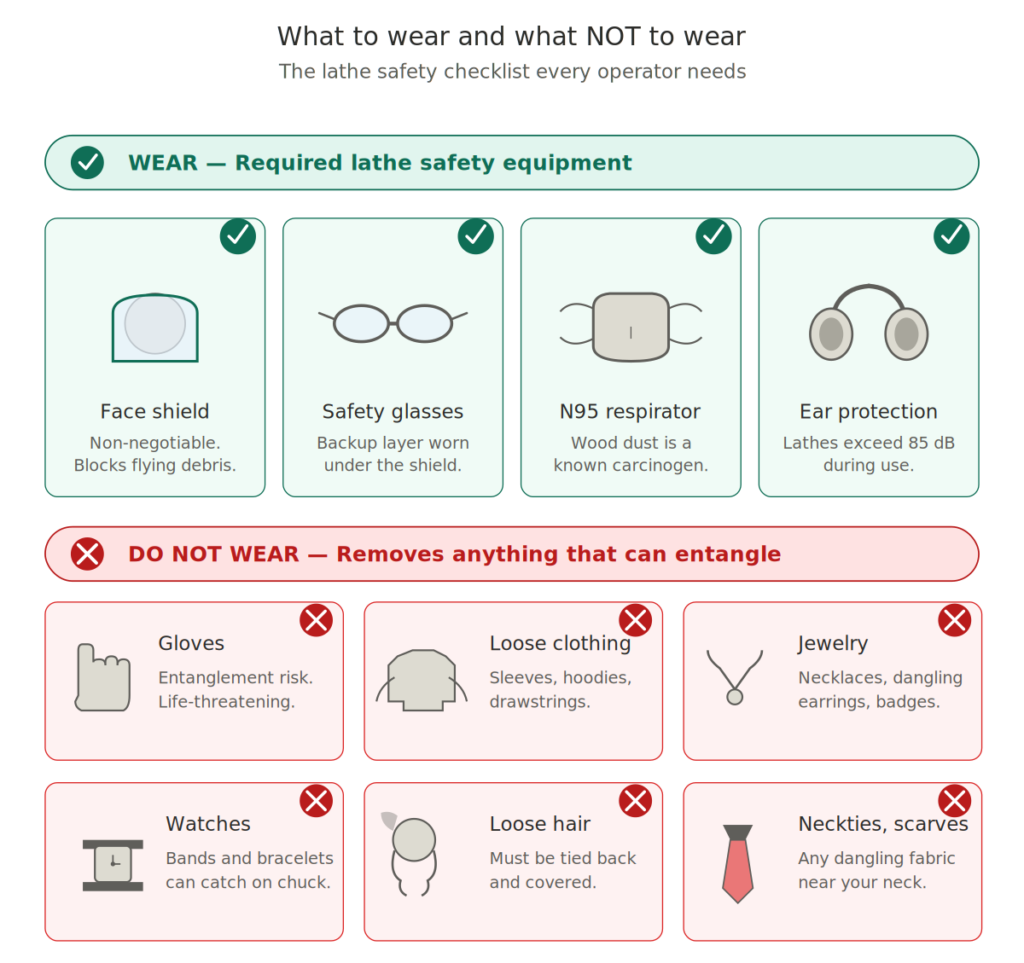
A face shield is the single most important piece of lathe safety equipment. It protects against ejected material, dust, and unexpected catches. Safety glasses alone are insufficient because they leave the mouth, nose, forehead, and cheeks exposed to chip impacts.
Best pick for turners: The Honeywell UVEX BIONIC face shield is the most popular choice among woodturners. It fits comfortably, does not fog like cheap versions, and is rated for high-impact protection.
→ Honeywell UVEX BIONIC Face Shield
Safety Glasses (Worn Under the Face Shield)
Safety glasses under the face shield provide backup protection if the shield lifts or slips. They also catch fine dust that might drift up under the shield when leaning close to the workpiece.
Respiratory Protection
An N95 respirator is the minimum for turning. Better options include half-face or full-face respirators with P100 filters for serious dust exposure, particularly for turners working with exotic woods or doing extensive sanding.
Budget option → 3M N95 Masks
Better protection → 3M Half-Face Respirator with P100 Filters
Premium all-in-one (impact + respiratory) → Trend Airshield Pro
Hearing Protection
Any hearing protection rated at 25 NRR (Noise Reduction Rating) or higher is adequate for lathe work. Muffs are typically more comfortable than plugs for extended sessions.
Hearing health is a critical aspect of workshop safety. Find out how much noise these machines generate in our article on whether lathes are loud and what hearing protection you need.
What NOT to Wear (This List Saves Lives)
- Gloves of any kind (major entanglement risk)
- Loose clothing including hoodies with dangling drawstrings
- Neckties, scarves, or bandanas hanging loose
- Necklaces, dangling earrings, or ID badges on lanyards
- Watches with loose bands or bracelets
- Long hair not fully tied back and preferably covered
- Open-toe shoes
If you’re deciding which tool fits your shaping projects best, explore our side-by-side comparison of a lathe vs. router to evaluate operation, safety, and project suitability.
The 10 Rules Every Lathe Operator Must Follow
- Always wear a face shield. Every session, every time, no exceptions. Even for a quick 30-second cut.
- Never wear gloves, loose clothing, or dangling jewelry. Secure long hair. If in doubt, take it off or tie it back.
- Inspect the workpiece before turning. Check for cracks, knots, splits, checks, or defects. Reject any wood that looks questionable. There is always more wood.
- Match speed to workpiece size. Larger diameters require slower speeds. Consult a speed chart if uncertain. Excessive speed on large pieces is the leading cause of workpiece ejection.
- Secure the workpiece properly. Between centers, in a chuck, or with a faceplate, verify it is tight before starting. Recheck after initial roughing cuts.
- Position the tool rest correctly. Close to the workpiece (about 1/8 inch clearance) at the correct height for the tool being used. Adjust only with the machine OFF.
- Take small cuts, especially when learning. Aggressive cuts cause catches. Multiple light passes are always safer than one heavy pass.
- Keep tools sharp. Dull tools require more force, are more likely to catch, produce more heat, and give less clean cuts. Sharpen frequently.
- Turn off the machine before any adjustment, measurement, or inspection. Every time. Wait for complete stop before reaching in.
- Never leave the lathe running unattended. Turn it off when you step away, even for 30 seconds. Never let non-operators approach a running lathe.
Special Considerations for Beginners
Lathes are among the more dangerous shop tools for beginners because control comes only with practice. A beginner’s first hour on a lathe carries dramatically higher risk than an experienced turner’s typical session, largely because the beginner does not yet recognize the signs of an impending catch or workpiece failure.
Take formal training if possible. Local woodworking clubs, community colleges, and chapters of the American Association of Woodturners (AAW) offer beginner classes. A few hours with an experienced instructor prevents many first-year injuries. This is one of the best investments a new turner can make.
Start with softer, simpler projects. Pine spindles and simple bowls teach fundamentals without the higher risk of turning hardwoods, large diameters, or fragile species. Master a spindle project before attempting a bowl. Master a small bowl before attempting a large one.
Practice tool control before making finished pieces. Time spent learning tool presentation, cutting angles, and catch response prevents accidents when you begin real projects. Turn practice pieces for a full week before your first real project.
Do not turn alone when starting out. Have someone in the shop who can help in an emergency. Keep a cell phone within reach at all times.
Should minors use lathes? Most experienced turners recommend 14 as a minimum age for wood lathes, with adult supervision required. Metal lathes require additional maturity due to heavier workpieces and cutting fluid exposure, and are typically reserved for supervised high school shop programs or older learners. Individual maturity, physical size, and instruction quality matter more than age alone.
What to Do When a Catch or Emergency Happens?
If a catch occurs: Your instinct will be to grip the tool tighter. This is wrong. Release the tool immediately and step back. Never try to control a catching tool through force, the spinning workpiece will always win.
If the workpiece comes loose: Do not try to catch it. Step back and let it come to rest. Turn off the machine before approaching.
If you are struck by an ejected piece: Stop the machine and assess. Facial impacts, even with a face shield, can cause concussions. Serious eye pain warrants immediate medical attention even if you were wearing eye protection.
For cuts: Wash the wound, apply pressure, and seek medical attention if the cut is deep, will not stop bleeding, shows exposed tissue, or was caused by a dirty tool.
For entanglement: If it happens to you or someone else, hit the emergency stop immediately. Most lathes have a large red button designed for one-handed activation. If your lathe does not have an emergency stop within easy reach, install one before your next session. This is not optional.
The Bottom Line
Yes, lathes are dangerous. But dangerous does not mean uncontrollable. The vast majority of lathe injuries are preventable with proper safety equipment, sound technique, and disciplined habits. Turners who work for decades without serious injury are not lucky, they follow the rules consistently.
If you are considering a lathe, do not let this article scare you away from a rewarding craft. Millions of people use lathes safely every year. Do respect the machine, invest in real safety equipment before you invest in the machine itself, take proper training, and follow the ten rules above every session.
Frequently Asked Questions
Are wood lathes more dangerous than metal lathes?
Not necessarily. They present different risks. Wood lathes cause more first-time user injuries due to accessibility and shorter learning curves. Metal lathes tend to produce more severe injuries when they occur due to heavier workpieces and sharper chips. Both require serious safety practices.
Can I use a lathe safely without a face shield?
No. Safety glasses alone leave the majority of your face exposed to ejected material. A face shield is the minimum standard for lathe operation. This is not an area to compromise.
Are mini lathes safer than full-size lathes?
Somewhat, because they typically handle smaller workpieces with less mass. But they still spin at high RPM and can eject material dangerously. The same safety equipment and rules apply. Mini lathes are not “beginner-safe” versions of full-size machines.
What is the most common lathe injury?
Face and eye injuries from ejected material, followed by hand contact injuries. Both are largely preventable with proper personal protective equipment (PPE) and safe operating practices.
At what age can someone safely learn to use a lathe?
Most experienced turners suggest 14 as a starting age for wood lathes with continuous adult supervision. Younger users can watch and assist but should not operate independently. Metal lathes generally require additional experience and are typically reserved for high school shop programs or older learners. Maturity and instruction quality matter more than age alone.
Do I need special training to use a lathe safely?
Formal training is strongly recommended, especially for beginners. Books and videos help but hands-on instruction from an experienced turner prevents mistakes that video cannot show. Local woodworking clubs and community colleges often offer affordable classes. Many chapters of the American Association of Woodturners host free beginner sessions.
Is turning exotic wood more dangerous?
Yes, in two ways. Some exotic woods (cocobolo, rosewood, wenge, ebony) can cause severe allergic reactions and respiratory issues, even from a single exposure. Many exotic woods are also denser and harder, requiring different tool control. Use enhanced respiratory protection and start with easier species before attempting exotics.
Can I be legally liable if someone gets hurt using my lathe?
Yes. If someone is injured using your lathe in your shop, you may face legal liability. Ensure anyone using your machine has proper training, uses your safety equipment, and understands the risks. Consider posting basic safety rules near the lathe and requiring a signed acknowledgment for anyone but immediate family.
What speed is safest for beginners?
For wood turning, start at 500 to 1,000 RPM for spindle work and go slower for larger diameters. Consult a speed chart specific to your machine. Excessive speed is a leading cause of accidents for beginners who assume “faster is better.”
Is a spinning lathe more dangerous than a table saw?
They are dangerous in different ways. Table saws produce more total injuries because more people use them, most involving fingers. Lathes produce fewer injuries per user, but a higher percentage of serious ones involving the face or entanglement. Neither should be operated without proper PPE and training.