
Is a Helical Cutterhead Worth It? Complete Buyer’s Guide
Affiliate disclosure: This article contains Amazon affiliate links. If you buy through them, we earn a small commission at no extra cost to you. Our recommendations reflect our real opinions after using both cutter head types in the shop.
The Short Answer
Yes, a helical cutterhead is worth it for anyone who uses their planer or jointer weekly, works with figured or hardwood species, or values quieter shop operation. The upgrade pays for itself over 3 to 5 years through longer insert life, cleaner cuts, and reduced tearout on difficult wood.
Skip the upgrade if you use your machine occasionally (a few boards per month), work primarily with softwoods, or are on a tight budget where a new machine makes more sense than upgrading an old one.
Best all-around helical cutterhead → Byrd Shelix Cutterhead
Best budget alternative → Grizzly Industrial Indexable Spiral Cutterhead
What Is a Helical Cutterhead?
A helical cutterhead (also called a spiral cutterhead) is a rotating cutter that uses many small carbide inserts arranged in a spiral pattern along its length. Each insert cuts a tiny slice of wood as the cutterhead rotates. This replaces the traditional straight-knife cutterhead that uses 2, 3, or 4 long steel blades running parallel to the axis of rotation.
The name “helical” refers to the spiral arrangement of the inserts. As the cutterhead spins, the inserts engage the wood one at a time in a sequential shearing action rather than all at once. This is fundamentally different from how straight blades cut, and produces the benefits we cover below.
Byrd Tool Corporation invented the modern helical cutterhead design (marketed as “Shelix”), and their design is now the de facto standard for aftermarket upgrades. Other manufacturers like Grizzly, Cutech, and various Chinese producers make similar spiral cutterheads at different price points.
The typical helical cutterhead uses between 18 and 60 individual carbide inserts, depending on the machine size. Each insert is a small square (usually 14mm) that can be rotated to 4 different cutting positions before replacement. This means a single set of inserts effectively lasts 4 times longer than it would if you could only use one edge.
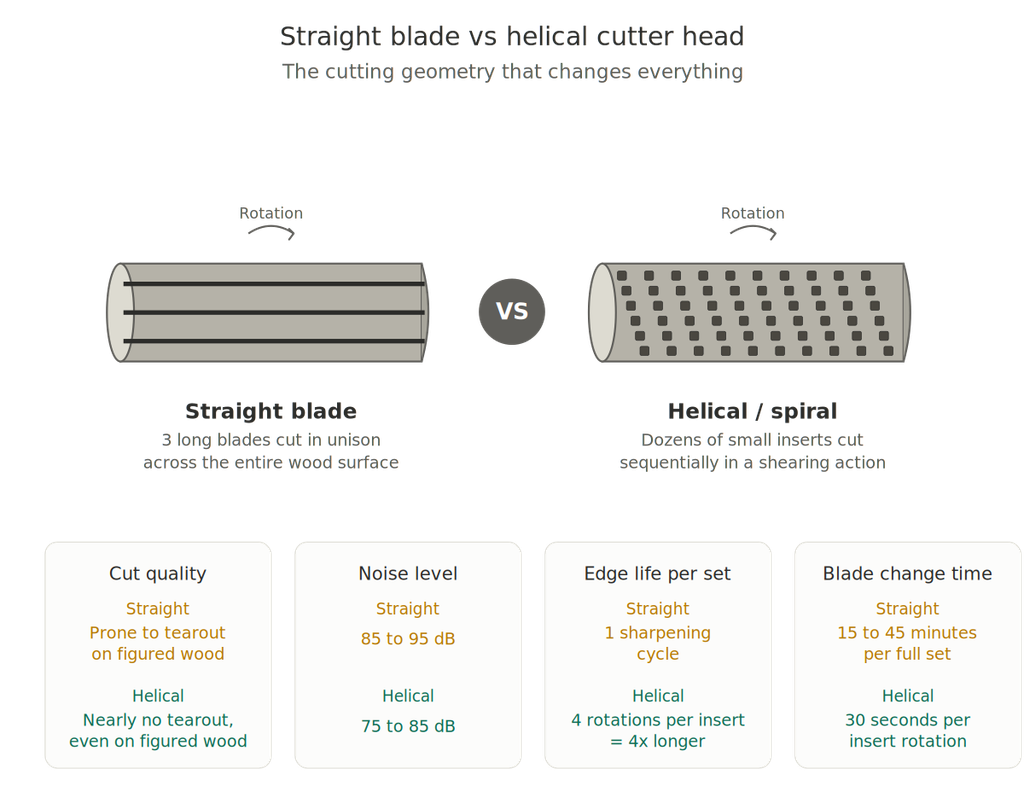
Helical Cutterhead vs Straight Blades: Head-to-Head
The core differences that determine whether the upgrade is worth it:
| Factor | Straight Blades | Helical Cutterhead |
|---|---|---|
| Cutting action | All blades engage at once | Inserts engage sequentially |
| Noise level | Loud (85 to 95 dB) | Quiet (75 to 85 dB) |
| Cut quality on figured wood | Prone to tearout | Nearly no tearout |
| Blade replacement time | 15 to 45 minutes | 2 minutes per insert |
| Sharpness restoration | Full blade replacement or sharpening | Rotate insert to new edge |
| Cost per replacement | $30 to $150 for a set | $2 to $5 per insert |
| Total edge life per set | 1 sharpening cycle | 4 rotations per insert |
| Debris | Long shavings | Fine chips |
| Chip ejection | Good | Excellent |
| Machine wear | Higher (vibration) | Lower (smoother operation) |
| Cut on end grain | Can splinter | Cleaner |
| Learning curve | Familiar to most | Different feed feel |
The helical design wins on 10 of 12 factors. Straight blades win only on initial cost and familiarity.
The 6 Real Benefits of Helical Cutterheads
1. Dramatically Better Cut Quality on Figured Wood
This is the biggest reason serious woodworkers upgrade. Curly maple, birdseye maple, quilted mahogany, bubinga, wenge, and other figured or exotic species tear out badly with straight blades because the grain direction changes constantly. Helical cutterheads shear the wood in tiny slices at an angle, virtually eliminating tearout.
If you work with figured or exotic wood regularly, this benefit alone justifies the upgrade cost.
2. Significantly Quieter Operation
Straight-blade planers and jointers produce a loud whining sound as all blades simultaneously slap into the wood at high RPM. Helical cutterheads produce a smoother, lower-pitched sound because inserts engage the wood one at a time. The noise reduction is roughly 5 to 10 decibels, which perceptually sounds like the machine is half as loud.
For anyone with a shop attached to a house, in a residential neighborhood, or with sensitive neighbors, this benefit is significant.
3. Much Longer Cutting Edge Life
Carbide is dramatically harder than the HSS steel used in straight blades. A carbide insert can last 10 to 20 times longer than a comparable HSS blade before dulling. And when an insert does dull, you rotate it 90 degrees to expose a fresh edge, meaning each insert provides 4 usable cutting edges before replacement.
Combined, this means the total cutting edge life of a helical cutterhead is roughly 40 to 80 times longer than a set of straight blades in equivalent use. Over 10 years of hobby woodworking, you might rotate inserts 2 or 3 times without ever replacing them.
4. Faster and Easier Blade Maintenance
Replacing straight blades is a 15 to 45 minute job involving removing gib locks, positioning replacement blades exactly at the right height, and precisely leveling them. Getting them wrong causes uneven cuts or snipe.
Rotating a helical insert takes 30 seconds with a Torx wrench. Loosen the screw, rotate the insert 90 degrees, retighten. No leveling needed because each insert sits in a machined pocket. Even replacing all 30 to 60 inserts on a full head takes maybe 30 minutes total, and requires zero setup afterward.
5. Reduced Vibration and Machine Wear
Straight-blade cutter heads produce more vibration because all blades engage the wood simultaneously. This vibration transfers to bearings, motor mounts, and the machine’s frame over time, causing accelerated wear.
Helical cutterheads engage the wood progressively, producing much smoother operation. Machines with helical heads typically last longer and require less bearing service over their lifetime.
6. Better Chip and Dust Ejection
The small chips produced by helical inserts eject through dust collection more efficiently than the long shavings from straight blades. This reduces clogging in dust collection ductwork and keeps the machine cleaner during use. Combined with the reduced noise, helical machines are simply more pleasant to run for extended sessions.
The 4 Real Drawbacks of Helical Cutterheads
Honest analysis requires acknowledging the downsides.
1. High Upfront Cost
A quality helical cutterhead for a 13-inch planer costs $350 to $500. For an 8-inch jointer, expect $500 to $800. For a 15-inch professional planer, $700 to $1,000+. This is a substantial investment on top of your existing machine.
Compare that to $30 to $80 for a replacement set of straight HSS blades and the initial cost gap looks larger than it really is over the machine’s lifetime.
2. Insert Replacement Costs Add Up
While individual inserts are inexpensive ($2 to $5 each), a full replacement set for a 15-inch cutter head can cost $150 to $250. If you damage many inserts at once (rare but possible with hidden metal or exceptionally hard wood), the replacement cost can approach the price of a new set of straight blades.
3. Slightly Slower Feed Rate
Because inserts engage the wood progressively rather than all at once, some woodworkers find helical cutters produce a slightly slower effective feed rate on very light cuts. In practice this is barely noticeable, but if you run production volume through your planer daily, factor in a 5 to 10 percent throughput reduction.
4. Not Every Machine Accepts a Helical Retrofit
Some older or budget planers and jointers have cutter head designs that cannot be retrofitted with a helical replacement. Byrd and other manufacturers list compatible machines on their websites. If your machine is not on the compatibility list, your only options are to buy a new machine with a helical head from the factory or stick with straight blades.
How Much Does a Helical Cutterhead Cost?
Real-world pricing as of publication:
Benchtop planer helical heads
- DeWalt DW735 replacement: $350 to $450
- Delta 22-580 replacement: $400 to $500
- Ryobi/Craftsman 13-inch: $300 to $400
Jointer helical heads
- 6-inch benchtop jointers: $250 to $400
- 6-inch floor jointers: $450 to $600
- 8-inch floor jointers: $600 to $800
- 12-inch floor jointers: $800 to $1,200
Industrial planer heads
- 15-inch planers: $700 to $1,000
- 20-inch planers: $1,000 to $1,400
- 25-inch and larger: $1,400 to $2,500+
If you’re considering a larger helical planer, see our JET 20 Helical Planer review for a real-world look at its cut quality, noise, capacity, and performance.
Additional costs to budget
- Torx wrench (if not included): $10 to $20
- Bearing replacement (some retrofits recommend it): $30 to $80
- Professional installation (optional): $75 to $150
Total realistic budget: $400 to $1,500 depending on machine size.
Best Helical Cutterhead Brands
Byrd Tool Corporation (Shelix) : Premium Standard
The original and still the most respected helical cutter head brand. Made in the USA with quality carbide inserts and precise machining. The compatibility list covers most popular planers and jointers. Higher price than alternatives but resale value and long-term reliability justify it.
Best for
Anyone who plans to keep their machine for 5+ years and wants the highest quality retrofit.
Grizzly: Best Value
Grizzly manufactures competent spiral cutterheads at 30 to 50 percent lower prices than Byrd. Quality is genuinely good, though the machining tolerances are slightly less tight and insert quality is one notch below Byrd. For casual hobby use, the price difference is worth the small quality trade-off.
Best for
Budget-conscious craftsmen or those with less-expensive base machines who don’t want to invest in Byrd.
Cutech: Best for Their Own Machines
Cutech is primarily known for benchtop jointers and planers that ship with helical heads from the factory. They also sell replacement cutterheads for their own machines. Not a major aftermarket player for other brands.
Best for
Anyone who owns a Cutech machine and needs replacement or upgrade parts.
Powermatic OEM : For Powermatic Owners
Powermatic sells OEM helical head upgrade kits for their planers and jointers. Prices are comparable to Byrd. Guaranteed fit for Powermatic machines but limited compatibility with other brands.
Best for
Powermatic machine owners who want factory-warranted parts.
Chinese Aftermarket : Buyer Beware
Amazon and eBay sell cheaper spiral cutterheads from various Chinese manufacturers at 50 to 70 percent off Byrd prices. Quality is highly variable. Some are perfectly functional, others have soft carbide, poor machining tolerances, or misaligned insert pockets. If you go this route, buy from a seller with return policy, inspect carefully on arrival, and accept the risk that quality may not match established brands.
Who Should Upgrade to a Helical Cutterhead?
Upgrade if you meet any of these criteria:
- You use your planer or jointer weekly or more often
- You work regularly with figured, curly, quilted, or exotic wood species
- Your shop is attached to a house or in a residential neighborhood (noise matters)
- Your existing machine has 10+ years of remaining life
- You have already invested in dust collection and other quality accessories
- You want to reduce time spent on blade maintenance
- You produce work where cut quality shows in the final product
Who Should Skip the Upgrade?
Stick with straight blades if any of these apply:
- You use your machine occasionally (a few boards per month)
- You work primarily with softwoods like pine, poplar, or cedar
- Your machine is older than 15 years and may need replacement soon anyway
- Your machine is not on the manufacturer’s compatibility list
- You have limited budget better spent on other tools
- You do rough milling where cut quality is not critical
How to Install a Helical Cutterhead?
Installation difficulty varies by machine. Some retrofits are 30-minute jobs, others require significant disassembly.
Easy retrofits (30 to 60 minutes)
- DeWalt DW735 series
- Delta 22-580 series
- Most JET benchtop planers
Moderate retrofits (1 to 3 hours)
- Powermatic 15-inch planers
- Grizzly floor-standing planers
- Larger JET floor models
Complex retrofits (may need professional service)
- Older industrial planers
- Machines requiring bearing replacement
- Any machine you’re not comfortable partially disassembling
For most common retrofits, you’ll follow this general process:
- Unplug the machine and remove the top cover
- Remove any belt guards
- Loosen or disconnect the drive belt
- Remove the bearing housings on each end of the existing cutter head
- Remove the old cutter head
- Install the new helical head with the correct rotation orientation
- Reinstall bearings, belt, and covers
- Test at low speed before running material
See our detailed installation guide for the DW735 for step-by-step instructions on the most common retrofit.
The Real ROI Calculation
Let’s compare 10-year costs for a hypothetical serious hobbyist running a 13-inch benchtop planer:
Straight blade scenario
- Blade replacements: 4 sets over 10 years at $60 each = $240
- Time spent on replacement: 2 hours per year at $25/hour = $500
- Noise-related concerns: no direct cost
- Cut quality issues on figured wood: occasional project rework
- Total 10-year cost: ~$740 plus intangibles
Helical cutterhead scenario
- Upfront helical head cost: $400
- Insert rotations over 10 years: minimal, occasional damaged insert replacement = $30
- Time savings on maintenance: significant
- Noise reduction: substantial quality-of-life improvement
- Cut quality: eliminates tearout on figured wood
- Total 10-year cost: ~$430 plus significant quality benefits
Net savings over 10 years: roughly $310, plus better cuts and quieter operation.
For occasional users (2 to 3 hours per month), the calculation runs the other way. Straight blades last much longer under light use, and the upfront $400 investment takes 15 to 20 years to break even. In that case, stick with straight blades.
The Bottom Line
For serious users and small shop professionals who use their planer or jointer weekly, a helical cutterhead upgrade is one of the best investments you can make in shop quality of life. Cleaner cuts, quieter operation, less maintenance, and a machine that will outlast the upgrade cost several times over.
For occasional users doing simple projects with dimensional lumber, the upgrade is harder to justify economically. Straight blades work fine for basic tasks, and the money is often better spent elsewhere in the shop.
The middle ground: if you’re planning to buy a new planer or jointer soon anyway, spend the extra $300 to $500 for a factory helical model rather than retrofitting later. The premium is smaller when built in at the factory than retrofit after purchase.
Ready to upgrade? For most common machines, the Byrd Shelix is the gold standard. For budget-conscious upgrades on less expensive machines, Grizzly’s spiral cutterheads deliver most of the benefits at a lower price. For a machine that comes with helical head from the factory, the JET JJ-6HHDX is a strong long-term investment.
FAQs
1) Is a helical cutterhead really 10x quieter than straight blades?
No, but it’s noticeably quieter. Real-world measurements show a 5 to 10 dB reduction, which subjectively sounds like the machine is roughly half as loud. It’s still not quiet enough to skip hearing protection.
2) Can I install a helical cutterhead myself?
For most retrofits, yes. If you can replace brake pads, you can install a helical cutterhead. If not, professional installation typically costs $75–$150.
3) Do helical cutterheads really eliminate tearout on figured wood?
They greatly reduce tearout but may not eliminate it in difficult woods. Highly figured cocobolo, quilted mahogany, and reversed-grain birch can still cause minor tearout, but they perform far better than straight blades.
4) How long do helical carbide inserts last?
Under moderate hobby use, inserts typically last 5–10 years before rotation and 15–25 years before replacement. Heavy production use shortens their lifespan.
5) Are cheap Chinese helical cutterheads any good?
Quality varies widely. Some match Byrd at half the price, while others have soft carbide, misaligned pockets, or defects. If buying one, choose a seller with a clear return policy and inspect it carefully on arrival.