
Are Jointer Blades Universal? Complete Sizing and Buying Guide
Affiliate disclosure: This article contains Amazon affiliate links. If you buy through them, we earn a small commission at no extra cost to you. Our recommendations reflect our real opinions after using multiple jointer setups in the shop.
The Short Answer
No, jointer blades are not universal. Blade length is determined by your jointer’s cutting width (a 6-inch jointer takes 6-inch blades, an 8-inch jointer takes 8-inch blades), and blade thickness, height, and mounting system vary by machine brand and model.
The good news: within a given size, aftermarket blades from brands like Powertec, Infinity Tools, and Freud fit many popular jointers as direct replacements. You do not have to buy manufacturer-branded blades if you know your exact specifications.
Best all-around HSS replacement → POWERTEC 148015 6-Inch Jointer Knives
Standard HSS replacement blades for 6-inch jointers, the most common home shop size. Universal fit for common 6-inch cutter heads.
Best carbide upgrade → Freud C441 8-Inch Jointer Knives
Industrial-grade carbide-tipped blades for 8-inch jointers. Holds an edge 10 to 20 times longer than HSS under normal use.
Best long-term upgrade → Byrd Tool H7769 Shelix Cutterhead (20-Inch)
A complete cutterhead replacement using rotating carbide inserts instead of straight blades. Produces a smoother finish, runs quieter, and lasts far longer than any blade replacement. Note: this specific H7769 model fits 20-inch industrial planers. Byrd makes similar Shelix cutterheads for 6-inch, 8-inch, 12-inch, and other machine sizes. Check compatibility with your specific jointer before ordering.
Why This Question Matters?
Jointer blades get dull. When they do, you have three choices: sharpen them, replace them, or upgrade to a spiral cutterhead. Any of those choices requires knowing exactly what fits your machine.
Buying the wrong blades is expensive. Blades run anywhere from $25 for a basic HSS set to $600 for a full spiral cutterhead. If you order the wrong size or the wrong mounting style, you cannot return an installed blade to Amazon, and manufacturer stores rarely accept returns on cutting tools once handled.
The universal-blade myth wastes money and time. This guide explains what actually varies between jointers, how to measure your existing blades, and which replacements work with the most common home and small-shop jointers.
Why Jointer Blades Are Not Universal?
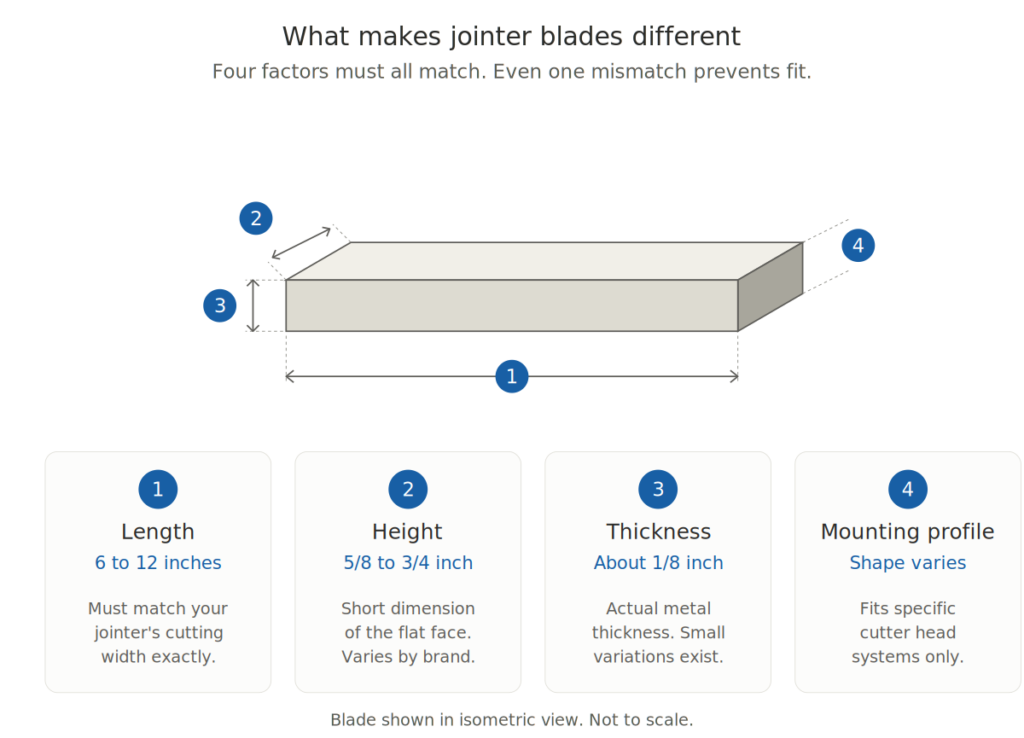
Four things vary between jointers, and any one of them can make a “close enough” blade the wrong blade.
1. Length (matches your jointer’s cutting width)
Jointer blades are cut to match the cutter head width, which matches your jointer’s stated cutting capacity. A 6-inch jointer takes blades roughly 6 inches long. An 8-inch jointer takes 8-inch blades. A 12-inch jointer takes 12-inch blades.
Common sizes and their typical machines:
- 6-inch (152mm): home shop jointers like the Delta 37-071, JET JJ-6CSDX, Grizzly G0725, Wahuda 50160CC-WHD
- 8-inch (203mm): serious hobbyist and small-shop jointers like the Grizzly G0490, Powermatic 60C, JET JJ-8CS
- 12-inch (305mm): professional jointers like the Grizzly G0609
- 16-inch and larger: industrial machines
Length is the first thing to check and the most obvious. Do not try to run an 8-inch blade on a 6-inch jointer or the reverse.
2. Height and thickness (varies by brand)
Two blades of the same length can have different heights and thicknesses. Height is how far the blade sits above the cutter head when properly installed. Thickness is the actual metal thickness of the blade. Both affect how the blade seats in the cutter head slot.
Typical 6-inch jointer blades run 5/8 inch tall and 1/8 inch thick, but exact specs vary. Delta 6-inch jointers usually take blades around 5/8 inch by 1/8 inch. Grizzly 6-inch jointers may take slightly different dimensions. Always measure or check your manual.
3. Number of blades
Most home jointers use 3 blades in the cutter head. Some older or budget machines use 2 blades. Higher-end jointers may use 4 blades for a smoother cut at higher feed rates. If your jointer takes 3 blades, do not try to run it with 2, and vice versa.
4. Mounting system
This is where compatibility gets tricky. Jointer cutter heads use different systems to hold blades in place:
Gib lock system: the most common. Blades sit in a slot and are held by a gib (a wedge-shaped bar) tightened with set screws. Powermatic, JET, Delta, and Grizzly all use variations of this. Even within gib-lock, the exact slot shape and screw pattern can differ by manufacturer.
Spring-loaded system: some Delta jointers and a few other brands use springs under the blades that push them up to a jack screw for height adjustment. Blades for these systems have a specific profile.
Disposable insert system: found on spiral cutterhead upgrades (Shelix, Grizzly Spiral). These use small carbide inserts held by Torx screws, completely different from straight blade replacement.
Blades cut for one mounting system do not fit another, even if length, height, and thickness match. This is the biggest reason “universal” blades do not exist.
How to Measure Your Existing Jointer Blades?
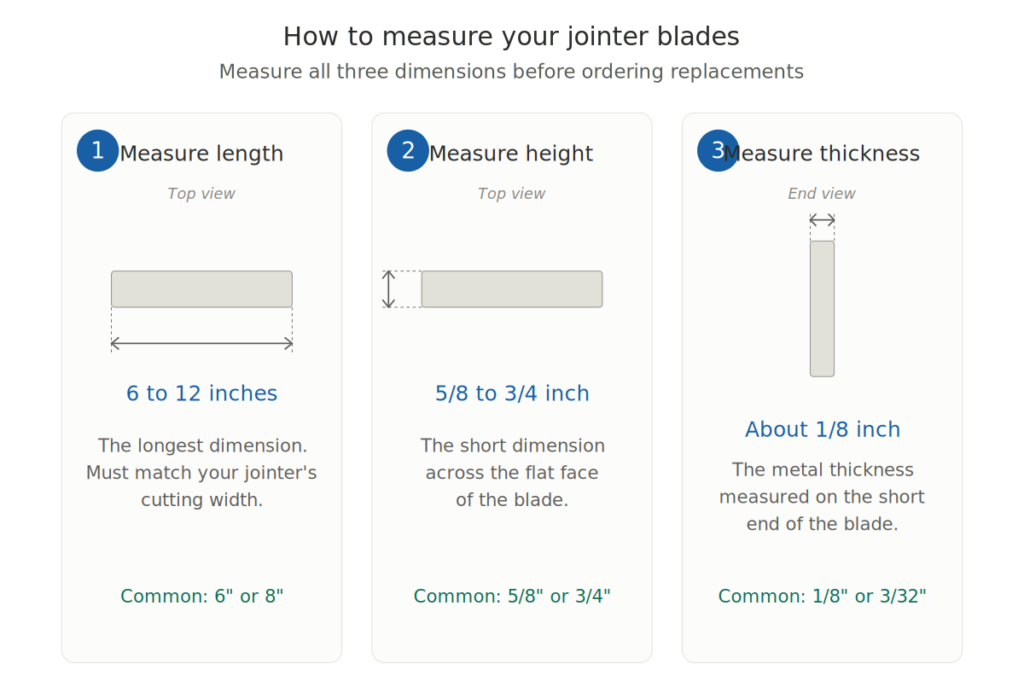
Before you buy replacement blades, measure what you have. This takes five minutes and saves the cost of a wrong purchase.
Step 1: Unplug the jointer. Never measure blades on a machine that is plugged in.
Step 2: Remove one blade from the cutter head. Loosen the gib lock screws (usually 3 or 4 screws along the blade) until the gib releases. Slide the blade out.
Step 3: Measure the length with a caliper or steel ruler. Round to the nearest 1/16 inch. Common lengths are 6, 8, or 12 inches.
Step 4: Measure the height (the short dimension across the flat face) with a caliper. Common heights are 5/8 inch on 6-inch blades and 3/4 inch on 8-inch blades.
Step 5: Measure the thickness with a caliper. Common thickness is 1/8 inch. Some blades are 3/32 inch.
Step 6: Note the mounting style. Are there set screws that pushed the gib into the blade? That is a gib-lock system. Are there springs under the blade slot? That is a spring-loaded system.
Step 7: Match your measurements to a replacement blade before ordering.
How to Buy Replacement Jointer Blades?
Once you know your specs, you have four buying paths, ranked by cost and quality.
Path 1: OEM manufacturer blades (highest cost, guaranteed fit)
Buy blades from your jointer’s manufacturer. Delta blades from Delta, Powermatic blades from Powermatic. Guaranteed fit, usually HSS, moderate to high price. Order through the manufacturer’s parts site or authorized dealers. Amazon carries some OEM blades but availability is inconsistent.
Path 2: Third-party HSS blades (best value)
Aftermarket HSS blades from brands like Powertec, Infinity Tools, or generic replacements sold under various Amazon brands. These cost 30 to 60 percent less than OEM and fit most common jointers if you match the specs. This is the buying path most hobbyists should use.
Best value option: POWERTEC 148015 6-Inch Jointer Knives → [Amazon Link]
Path 3: Carbide-tipped blades (premium upgrade)
Carbide-tipped blades cost 3 to 5 times more than HSS but last 10 to 20 times longer under normal use. Freud makes carbide-tipped jointer blades that fit many standard cutter heads. Worth the investment if you use your jointer weekly.
Best carbide option: Freud C441 8-Inch Carbide-Tipped Jointer Knives → [Amazon Link]
Path 4: Spiral cutterhead upgrade (long-term replacement)
Instead of replacing straight blades, replace the entire cutter head with a spiral cutterhead like the Byrd Shelix. This uses small carbide inserts (usually 26 to 36 on a 6-inch head) that produce a smoother finish, run quieter, and last far longer. Each insert can be rotated 4 times before replacement.
Cost is high ($400 to $700 for the cutter head assembly) but this is a one-time upgrade that eliminates blade replacement for years.
Best spiral upgrade: Byrd Tool H7769 Shelix Cutterhead (20-Inch)
Not every jointer accepts a spiral cutterhead retrofit. Confirm compatibility with the manufacturer before buying.
Complete List of Jointer Blade Options
For readers who want a broader view, here is every Powertec, Freud, and Byrd jointer blade option available on Amazon. The featured picks marked below are the strongest starting points for most home shops. The rest are worth considering for specific machines or use cases.
| Brand | Model | Type | Best For |
|---|---|---|---|
| POWERTEC | 14803V | HSS | Fits specific Craftsman jointer models |
| POWERTEC | 148015 (6-inch) | HSS | Featured pick. Standard 6-inch home shop jointers |
| POWERTEC | 14801DD | HSS | Craftsman-specific replacement blades |
| POWERTEC | 148020 (8-inch) | HSS | Standard 8-inch jointers |
| Freud | C491 | Carbide | Large industrial jointers |
| Freud | C350 | Carbide | Industrial planer/jointer combos |
| Freud | C573 | Carbide | Specific machine compatibility (check specs) |
| Freud | C310 | Carbide | Industrial planer/jointer combos |
| Freud | C460 | Carbide | 8-inch jointers (alternative to C441) |
| Freud | C441 (8-inch) | Carbide | Featured pick. Standard 8-inch carbide upgrade |
| Byrd | H7769 (20-inch) | Shelix cutterhead | Featured pick. 20-inch industrial planers |
| Byrd | Shelix (alternative model) | Shelix cutterhead | Verify specific machine compatibility |
Important buying tip: Always verify compatibility with your specific jointer model before ordering. Return policies on cutting tools vary, and installed blades are typically non-returnable. Cross-reference the exact blade dimensions listed in your jointer’s manual with each product’s stated specifications on the Amazon page.
HSS vs Carbide vs Spiral: Which Should You Buy?
High-speed steel (HSS)
- Standard blade material. Sharp out of the package. Easy to sharpen at home with a jig or a sharpening service. Best for occasional use.
- Typical lifespan under weekly hardwood use: 3 to 6 months before sharpening needed. 2 to 3 sharpenings possible before replacement.
- Best for: hobbyists, occasional users, budget-conscious buyers.
M2 high-speed steel
- An upgraded HSS grade with better edge retention. Costs 20 to 40 percent more than standard HSS. Lasts noticeably longer under repeated use.
- Best for: serious hobbyists who use their jointer weekly.
Carbide-tipped
- Carbide edges brazed onto steel bodies. Costs 3 to 5 times more than HSS. Lasts 10 to 20 times longer under normal use. Cannot be sharpened at home (requires professional service with diamond wheels).
- Best for: small production shops, cabinet makers, professionals.
Spiral cutterheads (Shelix, Grizzly Spiral, others)
- Not a blade type but a complete cutter head replacement. Uses small carbide inserts. Produces the quietest cut and smoothest finish of any option. Best for reducing tear-out on figured wood.
- Best for: anyone who has budget for the upgrade and uses their jointer regularly.
Signs Your Jointer Blades Need Replacement
Watch for these indicators:
- Tear-out on the wood surface, especially on figured or curly grain, even with proper feed technique.
- Burnishing or shiny streaks on the wood surface where the blade is compressing rather than cutting.
- Increased effort required to push wood across the jointer.
- Ribbed or scalloped patterns visible on the jointed surface.
- Chatter or vibration during cuts that was not present when blades were new.
- Visible nicks or chips in the cutting edge when inspected up close.
- Any one of these signs means the blades are due for sharpening. Two or more means it is time to replace.
How Often to Replace Jointer Blades?
Depends on use frequency and wood type. Approximate guidelines:
- Occasional amateur (a few boards per month): HSS blades last 2 to 3 years. Carbide lasts 8 to 10+ years.
- Regular amateur (weekly use): HSS blades last 6 to 12 months. Carbide lasts 5 to 7 years.
- Small production shop (daily use): HSS blades last 2 to 4 months. Carbide lasts 1 to 2 years.
- Spiral cutterhead inserts: individual inserts can be rotated 4 times each, and a full set lasts 3 to 5 years for most users before any insert replacement.
- Wood type matters. Hard maple, oak, and exotics wear blades faster than pine or poplar. Wood with hidden grit or sand can chip carbide (rare but possible).
Can Jointer Blades Be Sharpened?
Yes for HSS. Send them to a professional sharpening service or use a home jig. Cost is $8 to $15 per blade at a professional shop. A set of 3 blades can typically be sharpened 2 to 3 times before the metal is too thin.
Yes for carbide but only professionally. Requires diamond grinding wheels. Cost is $15 to $25 per blade. Carbide sharpens well and can be done multiple times.
Spiral cutterhead inserts are not sharpened. They are rotated to expose a new edge, then eventually replaced.
Common Compatibility Mistakes to Avoid
- Assuming brand loyalty means fit. Delta makes several jointer models with different blade specs. A blade that fits a Delta DJ-15 will not necessarily fit a Delta 37-071.
- Ordering by cutter width alone. “6-inch blades” is not enough information. Height, thickness, and mounting matter.
- Buying carbide expecting immediate results. Carbide takes longer to sharpen initially and produces a slightly different cut feel. Give yourself a week to adjust technique.
- Skipping the manual. Every jointer manual specifies exact blade dimensions. Reading it takes two minutes and prevents the wrong purchase.
- Trying to use planer blades in a jointer. Different tool, different specs. Planer blades are usually longer and cut differently. They do not fit jointer cutter heads.
Frequently Asked Questions
Are jointer blades the same as planer blades?
No. Jointer blades and planer blades serve similar cutting purposes but have different dimensions and mounting systems. A planer typically uses longer blades (12 inches or more), and the cutter head geometry differs. Do not attempt to interchange them.
Can I use 8-inch blades on a 6-inch jointer?
No. The blades will not fit in the cutter head slot, and forcing them creates a safety hazard. Blade length must match the jointer’s cutting width.
Do all Delta jointers use the same blades?
No. Delta has produced many jointer models over decades with different blade specifications. A Delta DJ-15 uses different blades than a Delta 37-071. Always verify against your specific model number and manual.
How much do replacement jointer blades cost?
Basic HSS sets run $25 to $60 for 3 blades. M2 HSS sets cost $50 to $100. Carbide-tipped sets run $120 to $300. Spiral cutterhead upgrades cost $400 to $700 for the complete head with inserts.
Are aftermarket jointer blades safe to use?
Yes, if they match your machine’s specifications exactly. Quality aftermarket brands like Powertec, Infinity Tools, and Freud produce blades that meet or exceed OEM standards. The safety risk comes from using the wrong-sized blade, not from using a non-OEM brand.
Should I upgrade to a spiral cutterhead?
Consider it if you use your jointer weekly, work with figured or difficult wood, want a quieter machine, or plan to keep your jointer for another decade or more. The upfront cost is high but the long-term value is strong.
Can I sharpen jointer blades myself?
HSS blades can be sharpened at home with a jig, though most woodworkers send them to a professional service. Carbide blades require diamond wheels and should always go to a professional. Spiral cutterhead inserts are not sharpened, only rotated.
The Bottom Line
Jointer blades are not universal. Length is set by your machine’s cutting width. Height and thickness vary between manufacturers. Mounting systems are proprietary. You cannot swap blades freely between brands.
But you also do not have to buy manufacturer-branded blades. If you know your exact specs (length, height, thickness, number of blades, mounting style), aftermarket blades from Powertec, Infinity Tools, and Freud fit most common jointers at 30 to 60 percent less than OEM prices.
The cheapest long-term option for most users is a set of quality HSS blades kept sharp. The best-value performance upgrade is carbide-tipped blades. The premium option is a spiral cutterhead retrofit, which eliminates blade replacement entirely for most users.
Whatever path you choose, measure your existing blades before ordering. That five-minute step prevents the most expensive mistake in this category.
Buying guide articles need different visuals than troubleshooting or product review articles. The reader here is deciding what to buy, so visuals should either explain WHY things vary (justifying research effort) or help them SELF-IDENTIFY the right product for their situation.